 mrsaynothing.dev
KV cache quantization — the bill your context hides
q8_0 keeps the KV cache at 17/32 of f16 and q4_0 at 9/32 — at 32k context the bill is 4608 MiB against a 2382 MiB model. Receipts, crossover, speed tax.
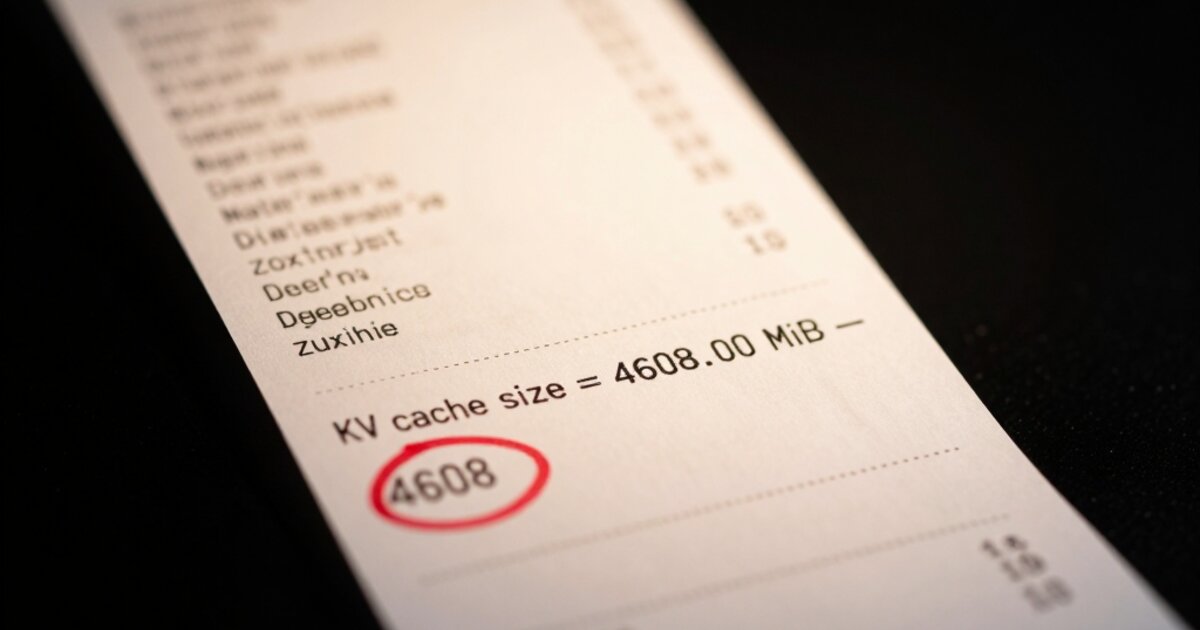
What is KV cache quantization? Storing the attention cache — the K and V tensors every past token contributes — in a smaller numeric format (q8_0 or q4_0) instead of 16-bit floats, so long contexts cost proportionally less memory. Measured on llama.cpp b12069, Qwen3-4B Q4_K_M: at 32k context the f16 cache bills 4608 MiB against a 2382 MiB model — q8_0 cuts that to 2448, q4_0 to 1296. The weights are a one-time purchase; the cache is the meter running.
Download the weights once — the context invoices every session.
What is KV cache quantization?
Claim: KV cache quantization lowers the numeric precision of the cache only — the K/V tensors — and never touches the weights on disk. Picture a hotel. The weights are the building: bought once, the same every night. Every token of context checks in as a guest, and K and V are its luggage — K is where that token's meaning lives, V is the meaning itself. Quantizing the cache is charging the guests for a smaller room: same guest, thinner luggage.
- K ("key") — the address of a past token's meaning: how relevant is token 400 to the word I just read?
- V ("value") — the meaning itself, delivered when the address matches.
- f16 / q8_0 / q4_0 — 16-bit, 8.5-bit and 4.5-bit storage. In llama.cpp the flag is
-ctk/-ctv; in Ollama it's theOLLAMA_KV_CACHE_TYPEenv var (public record — we did not re-bench Ollama here).
How much memory does the KV cache use?
Claim: per token, this model's f16 cache costs 144 KiB — 36 layers × 8 KV heads × 128 head_dim × 2 (K+V) × 2 bytes — and the loader's own boot lines print it to the byte. Two lines from the receipt, unedited:
llama_kv_cache: size = 4608.00 MiB ( 32768 cells,  36 layers,  1/1 seqs), K (f16): 2304.00 MiB, V (f16): 2304.00 MiB
llama_kv_cache: size = 1296.00 MiB ( 32768 cells,  36 layers,  1/1 seqs), K (q4_0):  648.00 MiB, V (q4_0):  648.00 MiB
verify: those are the size = lines llama.cpp prints at boot — captured, not transcribed. The full matrix, nine runs, one model:
| ctx | f16 (loader) | q8_0 (loader) | q4_0 (loader) | q8_0 ÷ f16 | q4_0 ÷ f16 |
|---|---|---|---|---|---|
| 4,096 | 576.00 MiB | 306.00 MiB | 162.00 MiB | 0.53125 | 0.28125 |
| 16,384 | 2304.00 MiB | 1224.00 MiB | 648.00 MiB | 0.53125 | 0.28125 |
| 32,768 | 4608.00 MiB | 2448.00 MiB | 1296.00 MiB | 0.53125 | 0.28125 |
Right two columns are arithmetic, not vibes: 17/32 and 9/32, exact — the block sizes make q8_0 store 8.5 bits and q4_0 4.5 bits per element, and the loader agrees to the byte on all nine rows.
The crossover, division printed: 2,381.59 MiB × 1024 ÷ 144 KiB/token = 16,935.7. Call it 17k. Below that, weights dominate; above it, you are officially paying more in rent than the flat cost.
Does KV quantization cost speed?
Claim: q8_0 is free; q4_0 costs about 9% of generation speed at depth — and the difference is bigger than the run-to-run wobble. Same nine runs, generation speed at each context:
| ctx | f16 gen | q8_0 gen | q4_0 gen |
|---|---|---|---|
| 4,096 | 7.04 tok/s | 6.98 tok/s | 6.68 tok/s |
| 16,384 | 7.07 tok/s | 6.99 tok/s | 7.04 tok/s |
| 32,768 | 7.19 tok/s | 6.97 tok/s | 6.55 tok/s |
Eval-time tok/s from verbose timing, 4-token generations. The wobble yardstick: prompt eval swung 13.35–14.0 tok/s across all nine identical setups — about ±0.3. f16→q8_0 at 32k is 0.22 (inside wobble); f16→q4_0 is 0.64 (−8.9%), past it.
The honest ledger: this is a CPU bench, 4-token generations — enough to price the dequant tax at 32k, not to write a manifesto. Prompt speed never moved (13.4–14.0 everywhere); the bill arrives only when generation walks a long cache. Our earlier GPU record agrees in direction: at 64K context, f16 KV ran 116 tok/s vs q4_0's 94 — on the bench where cache type was a VRAM necessity, not a speed choice.
When should you quantize the KV cache?
Claim: quantize when memory is the wall — q8_0 first, q4_0 only when the alternative is not running at all. The decision table:
- Everything fits at f16 — leave it. Lossless by construction, and it was the fastest at depth in both our benches.
- Context doesn't fit — q8_0: half-ish the cache, speed flat within wobble on this bench.
- Still doesn't fit — q4_0: less than a third of f16, roughly −9% generation at depth, and quality we did not re-measure here (our needle validations were f16-side; q4_0 cache quality is the public record's problem, not a number we'll invent).
The two knobs (public record)
llama.cpp: -ctk q8_0 -ctv q8_0 (or q4_0 / f16) on the server or CLI. Ollama: OLLAMA_KV_CACHE_TYPE=q8_0 as an environment variable — the autocomplete block behind this piece ("ollama kv cache type", "ollama kv cache quantization") is people looking for exactly that variable. Never mix K and V types; the slow path is real.
Two of our own receipts belong together here: the thinking bill itemized what a single "hi" costs when a model reasons; this piece is the other utility — rent, billed by context length, silently, forever. If you only remember one number: the meter passes the purchase price near 17k tokens, on a model small enough to fit in a jacket pocket.
last tested 2026-11-03 · llama.cpp b12069-e6192de0a · Qwen3-4B Q4_K_M (2,497,280,256 B) · CPU-only VM, 4 vCPU / 8 GB · receipts archived